gold · silver · news
Gold's Worst Quarter Since 2013: The Warsh Effect
Gold is down 14% this quarter — the steepest drop since 2013 — and one policy pivot is almost entirely to blame.
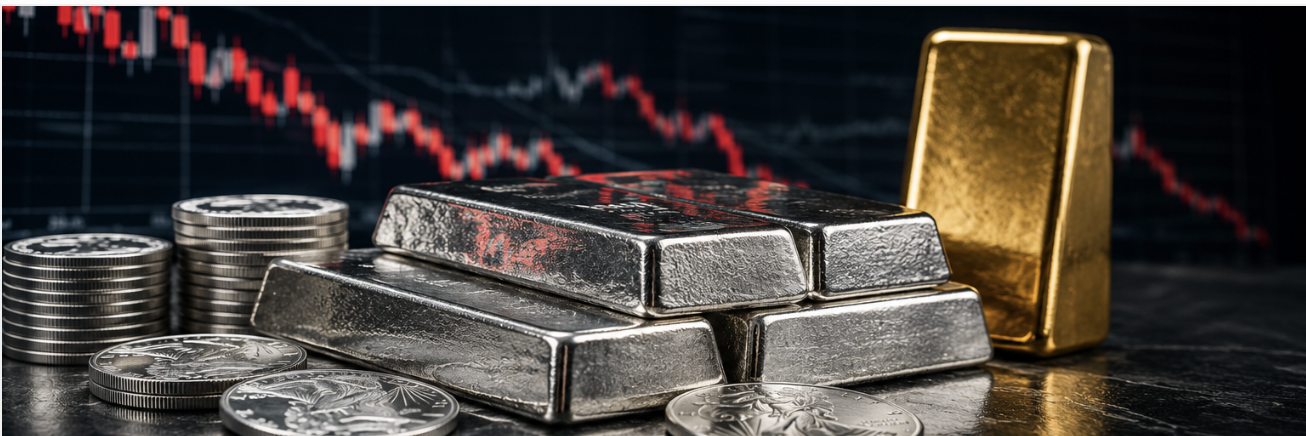
Gold ended Q2 2026 down 14% for the quarter, sitting at roughly $4,030 an ounce. That’s the steepest quarterly loss since Q2 2013 — back when Ben Bernanke mentioned “tapering” and the entire gold market had a collective panic attack. Silver is down nearly 20% since January. If you’re a stacker looking at your holdings right now, I understand the feeling. Let’s talk about what actually happened.
The Warsh Effect
On January 30, 2026, gold was coming off a record high near $5,595 an ounce. It closed that session down about 8%, near $4,941 — its worst day in decades. Silver fell far harder, its worst single day since 1980. Nothing changed in the economy that day. What changed was a name: Kevin Warsh was nominated as Fed Chair.
Warsh is hawkish in the way that restaurant critics are food-critical — it’s not a posture, it’s a worldview. When the Senate confirmed him on May 13 by 54–45 — the closest modern-era vote for a Fed chair — markets went to work repricing the entire interest rate landscape. At the start of 2026, rate cuts were priced in by December. After Warsh’s first meeting in June, the committee’s median projection for the year-end federal funds rate had moved up to 3.8%, and nine of eighteen participants were penciling in at least one hike.
On pure mechanics, that’s a headwind for gold. Higher real yields raise the opportunity cost of holding a non-yielding asset. Add in a strong jobs report in June, a CPI print at 4.2%, and a dollar that refuses to roll over — and you get Q2 2026: the quarter that felt like punishment.
What the Central Banks Are Actually Doing
Here’s what’s interesting: while the paper market was selling, the world’s largest institutional buyers were doing the opposite.
Central banks bought 244 tonnes in Q1 2026 alone, up 3% year over year and the fastest pace in more than a year. The World Gold Council’s latest survey finds 89% of reserve managers expect global central bank gold holdings to keep rising over the next 12 months, and a record 45% plan to add to their own. Central banks have run above 1,000 tonnes a year since 2022 — roughly double the 2010–2021 average of about 473 tonnes.
Poland led Q1 with 31 tonnes, Uzbekistan added 25, Kazakhstan 12. China’s 9.95 tonnes in May was its biggest single month since December 2024. These aren’t momentum traders. They’re not looking at a 30-day chart. They’re building strategic reserves for a decade-long shift away from dollar dependence, and they didn’t pause when Warsh got confirmed.
The divergence is striking: retail and institutional paper markets capitulating, while sovereign buyers accumulate. This is the kind of signal worth sitting with.
What This Means for Stackers
Silver deserves a separate note. It’s down 20% YTD, and the solar demand story got more complicated — photovoltaic silver demand is forecast to fall 19% this year to 151 million ounces, as manufacturers thrift silver out of each cell with zero-busbar designs and finer printing. But the silver market is still heading for its sixth consecutive annual supply deficit, at 46.3 million ounces. Mine supply is contracting faster than industrial demand is falling. The structural bid is intact.
For stackers, this quarter has a familiar shape. The macro narrative changed fast, prices followed, and the question now is whether you believe the short-term (hawkish Fed, strong dollar, paper selling) or the long-term (de-dollarization, supply deficits, sovereign buying at record pace).
Keep your stack schedule. A 14% correction doesn’t invalidate a thesis; it tests your conviction in it. The central banks aren’t flinching. You probably shouldn’t either.
Sources
- Gold losses ease after worst quarter in 13 years as interest rate fears hit bullion — CNBC
- Silver plunges 30% in worst day since 1980, gold tumbles as Warsh pick eases Fed independence fear — CNBC
- Kevin Warsh wins Senate confirmation as the next Federal Reserve chair — CNBC
- US Federal Reserve holds rates steady under new chair Warsh — Al Jazeera
- Gold Demand Trends: Q1 2026 — World Gold Council
- Silver Demand Forecast to Drop 19% in 2026 on Lower Solar Cell Loadings — Mercom India